


Cold Storage for Egg and Poultry Products: Sizing Basics
A cold storage system on a poultry farm is a refrigerated room, or set of rooms, that hold…

Check out our latest news,
 09:54
Before comparing prices, put nine terms in writing: warranty scope, spare-parts lead time, installation supervision, documentation handover, and five others covered below. These decide whether a poultry equipment supplier is still useful after the container is unloaded.
Ask which event starts the clock: shipment, delivery or commissioning sign-off. Ask what is excluded. Feeder parts, drinker nipples and other wear items are often excluded, and so is corrosion damage in houses with high ammonia. Write the warranty period as a number of months in the contract, and state whether replacement parts ship at the supplier’s cost.
Request a recommended spare-parts list with unit prices at the quotation stage, not after the first breakdown. Then ask for the lead time in days from the dispatch point to your port. A supplier .
Separate three arrangements: equipment-only supply, supply with remote video guidance, and supply with engineers on site. For on-site work, fix the number of supervision days, who covers travel and accommodation, and what counts as a finished installation. This is also where equipment-only quotes and turnkey EPC scope diverge, so name which one the price covers.
List the documents by name: layout and foundation drawings, equipment load data for the civil contractor, electrical diagrams, operation and maintenance manuals in a language your crew reads, and a parts catalog with part numbers. Ask for the civil drawings before shipment, since your builder needs them before the equipment arrives.
Mugong publishes company-level ISO 9001:2015, CE and SGS; model-specific certificate numbers are not published on its website, so ask for the one that applies to your model at quotation. The common misunderstanding is treating ISO 9001 as proof that a given cage performs well. Per the ISO standard, it describes a quality management system, meaning how the factory controls its processes. CE marking and SGS inspection address different questions again. Match each certificate to the claim you need it to support.
“Galvanized” covers a wide range. Write the coating type (hot-dip galvanized or aluminized-zinc) into the contract. Mugong states that its aluminized-zinc wire mesh has 3–4 times the corrosion resistance of ordinary hot-dip galvanized wire, and cites 500+ hours of salt-spray testing. Both are company-reported figures, so ask for the test report and the exact coating spec the test covered.
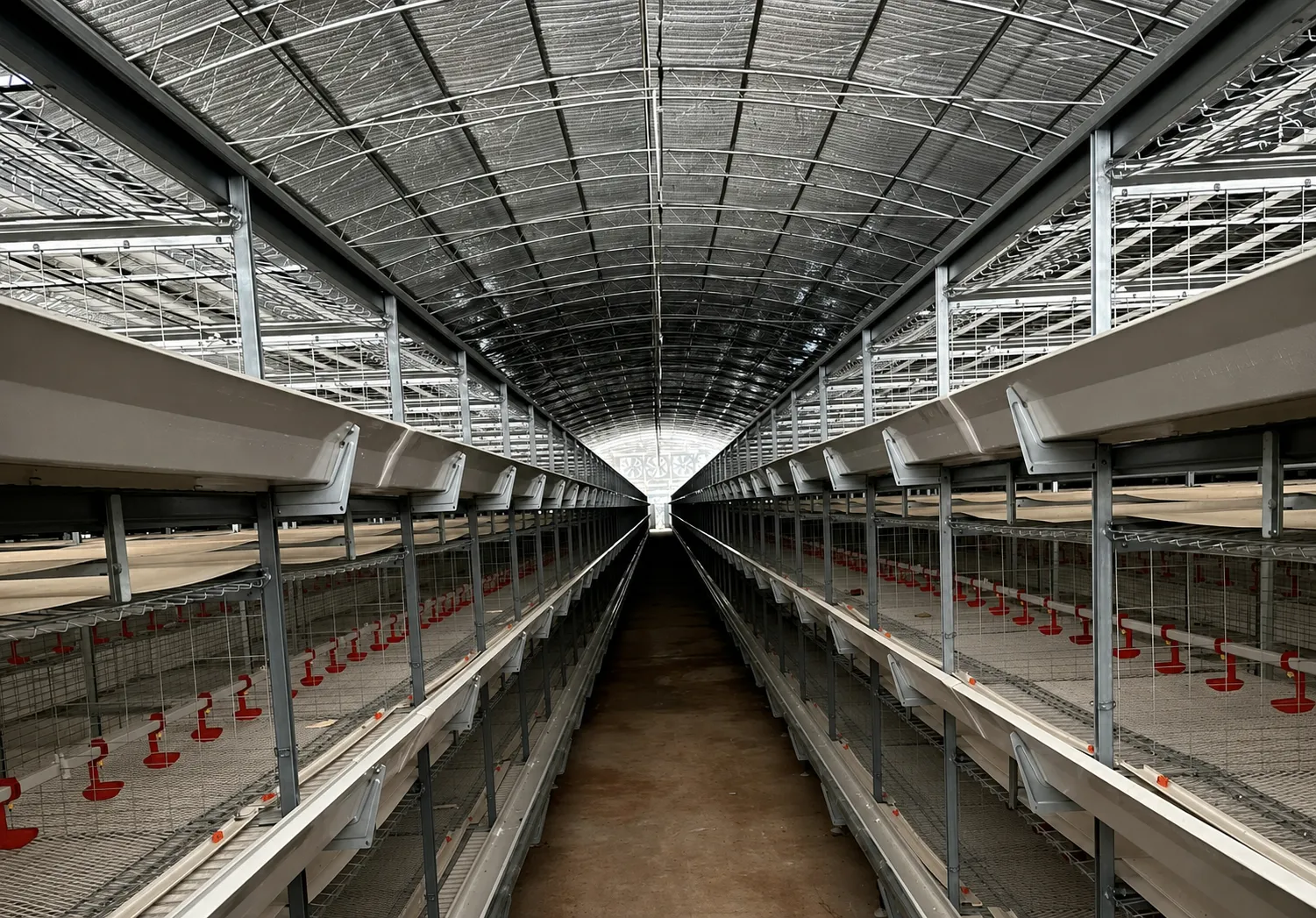
Ask what the price includes: cages only, feeding and drinking lines, climate control, steel house, freight, installation. Market-reference ranges for automatic layer cage projects run about US$15–25 per hen of capacity, and a 10,000-Hen layer cage project is typically around US$18,000–32,000 depending on automation depth and steel specification. A full turnkey project (cages, house, site works) is quote-only. The main price drivers are hen capacity and tier count, manual versus semi- versus fully automatic, galvanized versus aluminized-zinc structure, climate-control depth, steel-structure house or not, destination country (freight, certification, installation), and equipment-only versus EPC scope.
Link payments to events you can verify: order confirmation, shipping documents, commissioning sign-off. A final portion held until commissioning gives you leverage if installation goes wrong. Avoid paying everything before shipment unless you have verified the supplier’s references independently.
If you resell, your customer’s warranty claim reaches you first. Agree who diagnoses the fault, who ships the part, and whether you hold a small stock of wear parts locally. For OEM or ODM supply, add who owns the drawings and tooling, and whether your branding changes the warranty.
| Term | Ask for | Weak answer |
| Warranty | Months, start event, exclusion list | “Quality guaranteed” |
| Spare parts | Part list with prices, lead time in days | “We stock everything” |
| Installation | Supervision days, travel cost owner, acceptance criteria | “Our engineers will help” |
| Documents | Named drawings, manuals, parts catalog | “Manual included” |
| Certificates | Certificate for your model | Company logo wall only |
| Coating | Coating type and test report | “High-quality galvanized” |
| Price basis | Itemized scope | One total with no scope |
| Payment | Milestones tied to documents | Full prepayment |
Warranty start date, spare-parts lead time and back-to-back claim handling. They determine how fast you can answer your own customer.
No. It covers the factory’s quality management system. Ask separately which certificate applies to the specific model.
Only through a project quotation. Cage price is a small piece, while the house, ventilation and site works vary widely, so no honest single number exists.
Market references put equipment for a 10,000-hen layer cage project around US$18,000–32,000, depending on automation and steel specification. A real quote depends on scope and destination.
Send hens capacity, species, automation level, destination country and whether you need equipment only or turnkey. Contact: peter@poultryequipmentmanufacturers.com or +86 133 6144 9578 (WhatsApp).
Before your next quote request, check whether your destination country requires a certificate or import document beyond the three above. Local requirements vary, and this article does not cover them.
A cold storage system on a poultry farm is a refrigerated room, or set of rooms, that hold…
A poultry equipment quote is the price for a defined scope of cages, feeding, drinking, eg…

We will reply to your inquiry within 24 hours.For urgent inquiries, please contact us via WhatsApp: +86 133 6144 9578 or call us directly.
*We respect your privacy. All information submitted is strictly confidential.
Your details will only be used to respond to your inquiry. We never send unsolicited emails or promotional messages.