











Sourcing Poultry Equipment Manufacturers in China: Buyer Guide
Sourcing poultry equipment from a Chinese manufacturer means controlling four variables di…

اطّلع على آخر أخبارنا,
 14:14
14:14 Poor ventilation quietly hurts bird health, feed efficiency, and litter quality. When air exchange is wrong, heat, moisture, ammonia, and stale air build up fast. The fix is simple in principle: choose the right ventilation system and manage it well for each age, season, and house type.
The main types of ventilation in poultry are natural ventilation, minimum ventilation, transitional or side ventilation, and tunnel ventilation. Most modern poultry houses use negative-pressure mechanical systems with fans, inlets, and controls to match airflow, temperature, humidity, and bird age. The best system depends on climate, house size, bird density, and production goals.
Ventilation in Poultry
What does ventilation in poultry really do?
What are the main types of ventilation in a poultry house?
What is minimum ventilation and why does it matter so much?
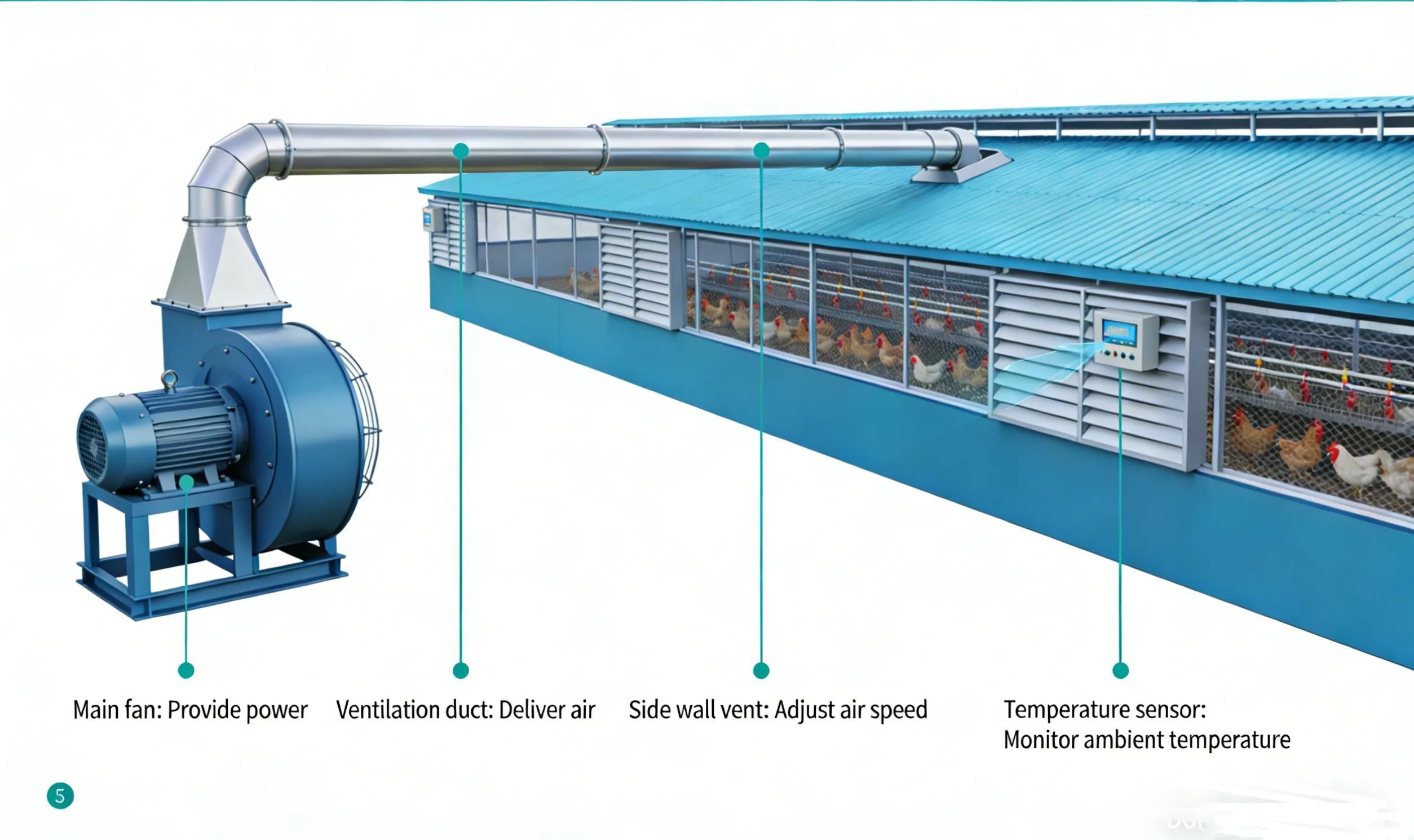
How does mechanical ventilation work in modern poultry houses?
What is tunnel ventilation and when should you use it?
How do inlet design and negative pressure affect airflow?
What is the role of cooling pads, exhaust fans, and other ventilation equipment?
How does ventilation change between broiler, layer, and rabbit projects?
What are the most common ventilation management mistakes?
How do you choose the right poultry ventilation system for your farm?
In simple terms, ventilation removes stale air and brings in fresh air. That sounds basic, but in a working بيت الدواجن, it controls far more than smell. Good ventilation helps regulate house temperature, reduce humidity, remove excess gas such as ammonia and carbon dioxide, protect litter quality, and improve overall air quality for birds and workers. Extension and poultry engineering sources consistently describe it as one of the most important environmental systems in modern poultry production.
A good system also manages airflow and air movement so the environment stays more uniform throughout the house. That matters because birds do not live in an “average” house. They live in one corner, under one inlet, near one sidewall, or in one hot or damp zone. Uneven air flow creates uneven bird performance. Proper ventilation is really about building a stable house environment from end to end.
From our engineering work on turnkey poultry and rabbit projects, we see this every time: a strong building, feeders, drinkers, and cages cannot perform well without stable ventilation management. That is why a complete poultry project should always connect housing, climate control, and manure handling into one coordinated system.
The common type of ventilation used in poultry includes natural ventilation, minimum ventilation, transitional or side ventilation, and tunnel ventilation. Some guides explain them slightly differently, but the working idea is the same: each method moves air in a different way and serves different weather and bird-age conditions.
Natural ventilation relies on wind and temperature difference. Air moves through openings like curtains, vents, ridge openings, or side openings without heavy fan use. This can work in some open-sided or mild-climate houses, but it offers less precise control than a negative-pressure fan-driven system. Modern enclosed houses more often depend on mechanical ventilation because it is more predictable and easier to automate.
In practice, many houses use more than one mode across the production cycle. A house may use minimum ventilation in cold weather or brooding, shift to transitional airflow as birds grow, and then move into maximum ventilation or tunnel ventilation in hot weather. That is why many people talk about different ventilation stages rather than one fixed mode.
Minimum ventilation is the smallest amount of air exchange needed to maintain oxygen, control moisture, and protect litter and bird health without dropping the target house temperature too much. It is especially important during brooding and colder weather, when growers want to conserve heat but still need to remove moisture and stale air. Mississippi State and other poultry ventilation references stress that this is not optional “extra air.” It is essential daily management.
A key point is that minimum ventilation rate is not mainly about cooling. It is about moisture and air quality. If growers under-ventilate, the air stays damp, the litter gets wet, and ammonia rises. If they over-ventilate, heating costs climb and birds may chill. Good minimum ventilation sits in the narrow middle where stale, moist air is removed but bird comfort is protected.
This is why many small fans are used for minimum ventilation on timers or variable control. The system must pull just enough air through the right air inlet openings so the cold incoming air mixes with warmer ceiling air before reaching birds. That mixing step is critical. Without it, the air drops directly onto chicks and creates drafts.
In most enclosed poultry buildings, mechanical ventilation means fans move air out while a slight negative pressure pulls replacement air in through designed inlets. The fans do not just remove air; they also create the pressure difference that makes the whole system work. University poultry engineering guidance describes this as the most common arrangement in enclosed houses.
That pressure-driven method is often called negative pressure ventilation or a negative pressure system. The idea is simple: the fans lower the pressure inside the house, and then air enters through controlled openings instead of random leaks. When the building is tight and the inlets are right, the air can be directed where it needs to go. When the building leaks too much, the system loses control.
This is why ventilation requires more than just fans. A complete نظام التهوية includes inlets, controllers, sensors, fan staging, sealing, and layout. In a well-designed ventilated house, the air is not just exchanged. It is deliberately distributed to support bird health and productivity.

Tunnel ventilation moves air the length of the house from one end to the other. Typically, air enters through tunnel openings or evaporative cooling pads at one end and is pulled by large fans at the opposite end. This creates high-speed airflow that cools birds through the wind-chill effect. It is widely used in larger broiler buildings and hot-weather production.
In simple terms, tunnel ventilation is often the answer when heat load becomes too high for sidewall-based exchange alone. In tunnel ventilated houses, strong air speed helps with cooling the poultry, and the addition of evaporative cooling can lower the incoming air temperature further in dry and hot conditions.
This does not mean every house should stay in tunnel mode all the time. Tunnel ventilation is excellent in hot weather, but it is not the right answer for every bird age or every outdoor condition. During brooding or mild weather, growers often need more controlled air mixing instead of maximum speed. Good design means switching modes as ventilation needs change.
The inlet is one of the most important parts of the entire system. Penn State notes that inlets may be the most important single part for keeping conditions uniform around the house. The reason is simple: fans can move air out, but the air inlet decides how that replacement air behaves when it enters.
With proper negative pressure, the air enters the house fast enough to travel along the ceiling, mix with warmer air, and then settle evenly into the bird zone. During minimum and transitional operation, sidewall inlets should be adjusted so air does not fall straight down near the walls. Aviagen and PoultrySite both emphasize that the inlet should direct air upward and away from birds to create uniform conditions along the house.
If the pressure system is wrong, the result is poor distribution. The air may short-circuit, drop too early, or fail to reach the center of the building. That is why ventilation helps only when the building is tight, the sidewall controls are accurate, and the fans match the inlets. In other words, good house ventilation starts at the openings, not just at the fan motors.
Large poultry houses depend on coordinated ventilation equipment. This usually includes exhaust fans, tunnel fans, minimum-vent fans, cooling pads, curtains or vents, controllers, sensors, and sometimes static-pressure gauges. Each part has a job. The fans create the pull, the inlet shapes the air path, and the controller decides when each stage runs.
Cooling pads are mainly used during warm periods in tunnel-ventilated houses. As air passes through wet pad material, evaporation cools the air before it moves through the house. This helps reduce temperature inside the house and supports bird comfort during peak heat. Air speed and pad performance work together, so pad systems are most effective when fan capacity and tunnel layout are properly matched.
From a turnkey project view, this is why we do not treat feeders, drinkers, steel buildings, and climate control as separate products. The best result comes when ventilation equipment is engineered as part of the total poultry project.
A broiler house normally faces rapid changes in bird size, heat output, and moisture load during one short flock cycle. Young chicks need careful minimum air exchange and warming. Older birds need much higher rates, especially in hot weather. That is why broiler houses often move through several stages, from minimum ventilation to transitional airflow and then to tunnel mode.
Layer and breeder projects may have different stocking patterns, equipment layout, manure handling intervals, and building geometry. These affect airflow, manure-drying goals, and جودة الهواء targets. Rabbit houses can require different drafts, temperatures, and humidity control again. The core rule stays the same: the ventilation method must fit the animals, house size, stocking density, and climate.
That is why serious investors and distributors should look for an engineering supplier, not only equipment sellers. In our own work, we connect steel structure, cage layout, feeding, drinking, climate control, and manure treatment so the final system supports real poultry production, not just equipment delivery.
One major mistake is assuming more air is always better. It is not. Poorly adjusted ventilation rate can chill birds in cold weather or fail to cool them in heat if the air path is wrong. The target is not “maximum fan use.” The target is the right exchange, in the right direction, at the right time.
Another common problem is ignoring the inlet. Growers often focus on fan count while forgetting that poor air inlet settings can ruin the whole house pattern. If air drops at the wall, dead zones form. If the house leaks, the intended flow pattern breaks. That leads to wet litter, inconsistent bird growth, more humidity, and avoidable ventilation issues.
A third mistake is treating the system as seasonal instead of daily. Good ventilation management means adjusting for bird age, outside weather, stocking level, and house condition. What worked last week may not work now. That is why poultry farmers need clear control logic, trained staff, and equipment that responds well. A stable system produces better air quality and better flock performance.
The right answer begins with climate, bird type, building style, and production target. Open-sided houses in mild regions may use more natural airflow, while enclosed farms in demanding climates usually need a controlled negative-pressure ventilation system. Large-scale broiler operations often depend on minimum, transitional, and tunnel stages in one integrated design.
Use this simple framework:
| Question | ما أهمية ذلك |
|---|---|
| What birds are you raising? | Broilers, layers, breeders, and rabbits do not have identical needs. |
| What is the climate? | Heat, cold, and humidity change fan, inlet, and pad design. |
| How tight is the building? | Tight buildings support better negative pressure control. |
| What is the building size? | إن length of the building and width influence air path and fan capacity. |
| Do you need cooling pads? | Important in hot-weather tunnel designs. |
| How will manure be managed? | Moisture load affects التهوية demand. |
For many investors and integrated poultry companies, the safest choice is a partner that can engineer the full system. We believe the right ventilation setup is the one that matches the whole project, not just one catalog product.
| النظام | أفضل استخدام | الميزة الرئيسية | الحذر الرئيسي |
|---|---|---|---|
| Natural ventilation | Mild climates, open-sided houses | Lower mechanical dependence | Less precise control |
| Minimum ventilation | Brooding, cold weather | Moisture and gas control with heat retention | Easy to under- or over-run |
| Transitional / side ventilation | Mild to warm periods | Better mixing and controlled exchange | Needs good inlet adjustment |
| Tunnel ventilation | Large enclosed houses, hot weather | Strong cooling and air speed | Not ideal for all bird ages or conditions |
This table shows why there is no universal “best” type of ventilation. The best system is the one that delivers effective ventilation, sufficient ventilation, and a uniform environment inside the house under real farm conditions.
What are the main types of ventilation used in poultry houses?
The main types are natural ventilation, minimum ventilation, transitional or side ventilation, and tunnel ventilation. Many modern houses combine these modes across the flock cycle rather than using just one all the time.
Why is minimum ventilation so important?
Because it removes moisture and stale air without sacrificing too much heat. It protects litter condition, reduces ammonia risk, and helps maintain bird comfort, especially during colder periods.
How does negative pressure ventilation work?
Fans remove air from the building, creating lower pressure inside than outside. That pressure difference pulls air in through designed inlets, which lets the grower control where the air goes and how it mixes.
When should a poultry house use tunnel ventilation?
Usually during hot weather or when bird heat load is high, especially in larger enclosed broiler houses. Tunnel mode provides high-speed airflow and often works with cooling pads for additional temperature reduction.
Are inlets really that important?
Yes. Several poultry ventilation sources say the inlet is one of the most important parts of the system because it determines how replacement air enters, mixes, and spreads. Bad inlet adjustment can ruin otherwise good fan performance.
What should I look for when buying a poultry ventilation system?
Look at building type, bird species, climate, control logic, fan capacity, inlet design, cooling options, sealing quality, and whether the supplier understands the full project. A strong engineering supplier should connect housing, feeding, drinking, climate, and manure handling into one plan.
Ventilation is crucial for bird health, litter quality, moisture control, and stable production.
The main systems are natural ventilation, minimum ventilation, transitional ventilation, and tunnel ventilation.
Most enclosed modern poultry houses rely on negative pressure ventilation.
The inlet is just as important as the fan because it shapes air direction and mixing.
Tunnel ventilation is powerful in heat, but not the right mode for every condition.
Good design connects fans, inlets, pads, building tightness, and controls into one system.
The best poultry project is not just a house with fans. It is a coordinated engineering solution for the whole farm.
Sourcing poultry equipment from a Chinese manufacturer means controlling four variables di…
A steel structure poultry house is a prefabricated steel building designed for layer, broi…
سنرد على استفسارك في غضون 24 ساعة. للاستفسارات العاجلة، يرجى الاتصال بنا عبر WhatsApp: +86 133 6144 9578 أو الاتصال بنا مباشرة.
*نحن نحترم خصوصيتك. جميع المعلومات المقدمة سرية للغاية.
سيتم استخدام بياناتك فقط للرد على استفسارك. نحن لا نرسل أبدًا رسائل بريد إلكتروني أو رسائل ترويجية غير مرغوب فيها.