











What Is the Best Layout for a Chicken Coop? A Practical Chicken Coop Design Guide for Healthy Flocks and Easy Management
A bad coop layout can lead to wet bedding, broken eggs, dirty feeders, poor airflow, and s…

 11:53
11:53 Choosing the wrong house can hurt bird comfort, raise labor cost, waste feed, and reduce egg or meat results. Poor layout also creates manure, ventilation, and disease problems. The smart solution is to match the right poultry house and system to your bird type, farm size, and production goal.
The main types of poultry housing include deep litter houses, slatted floor houses, cage systems, cage-free aviary systems, free-range systems, brooder houses, broiler houses, breeder houses, and specialized duck or turkey houses. The best option depends on whether you raise layers, broilers, breeders, or chicks, and whether your farm needs low cost, high automation, better egg collection, or more outdoor access.
What is poultry housing and why does the house type matter?
What are the main types of poultry housing systems?
What is a deep litter poultry house?
What is a cage system for layers and breeders?
What are cage-free systems, colony systems, and aviary houses?
What type of house is best for broilers and meat production?
What are brooder houses and rearing houses used for?
How do free-range and pasture systems compare?
What building and support systems does a modern poultry house need?
How should buyers choose the right poultry housing system?
A Nhà nuôi gia cầm is more than a shelter. It is the working environment where the bird eats, drinks, rests, lays, grows, and stays protected. A good house helps maintain the right temperature, feed and water flow, manure handling, air quality, and labor efficiency. Maryland Extension notes that poultry housing should protect birds from weather, predators, injury, and theft, and should be tight, well ventilated, insulated, and placed in a well-drained area with access to water and electricity.
The type of house matters because different birds need different conditions. A layer farm focused on table eggs does not use the same setup as a broiler meat farm. A chick rearing project needs a different environment from a breeder house. FAO notes that in developing countries, large-scale commercial farms often use clear-span structures with litter on the floor for meat birds or cages for laying hens, while small-scale systems may use much simpler housing.
That is why professional planning matters. If you are building a full poultry project, the housing choice should connect with steel-structure poultry house solutions, feeding, drinking, climate control, and manure handling, not just the walls and roof. Your housing decision affects bird welfare, labor, hygiene, and long-term return on investment.
The common housing systems used in modern poultry farming can be grouped into a few broad categories: deep litter, slatted floor, cage, cage-free/aviary, free-range or pasture-based, brooder houses, broiler floor houses, and breeder houses. FAO describes deep litter as a system where birds are fully confined on a litter-covered floor, while commercial literature and extension references also distinguish cages, slats, and cage-free alternatives.
For practical farm planning, the list often looks like this:
| Housing type | Best for | Main feature |
|---|---|---|
| Deep litter house | Broilers, some layers, small-medium farms | Birds stay on litter-covered floor |
| Slatted floor house | Breeders, some mixed systems | Birds stay partly or fully on raised slats |
| Cage system | Layers, breeders, pullets | More controlled egg collection and manure flow |
| Cage-free systems | Lớp | Hens move more freely with nest, perch, litter |
| Aviary | Lớp | Multi-tier cage-free indoor house |
| Free-range / pasture | Layers, specialty birds | Outdoor access added |
| Brooder houses | Chicks / young birds | Warm, protected early-stage rearing |
| Broiler houses | Meat chicken | Floor-based, high-capacity meat production |
| Breeder houses | Parent stock | Nest, mating, feed control, fertility focus |
| Duck / turkey houses | Khác types of poultry | Species-specific layout and management |
This is the simplest answer to different types of poultry housing: the right system depends on the production purpose, the bird type, and how much automation the producer wants.
A deep litter house is one of the most widely used systems, especially for broilers and some layer or dual-purpose flocks. In this setup, birds live on the floor, which is covered with absorbent litter such as straw, husks, or wood shavings. FAO describes deep litter as a system with 5 to 10 cm of litter material and notes a typical density of about 3 to 4 birds per square meter in the house.
The main advantage of deep litter is simplicity. It is relatively easy to understand, easier to start on many farms, and suitable where producers want birds to move freely inside the house. It is common in broiler production and in smaller operations because it does not require a complex cage layout. But the house must be managed carefully. Wet litter increases manure problems, ammonia, disease pressure, and poorer foot condition.
For many medium and large commercial farms, deep litter is still a useful system, but it works best when connected with good ventilation, reliable feed and water delivery, and planned manure management. That is why many buyers combine floor housing with farm support and auxiliary systems such as ventilation, heating, cooling pads, air inlet windows, and environmental controllers.
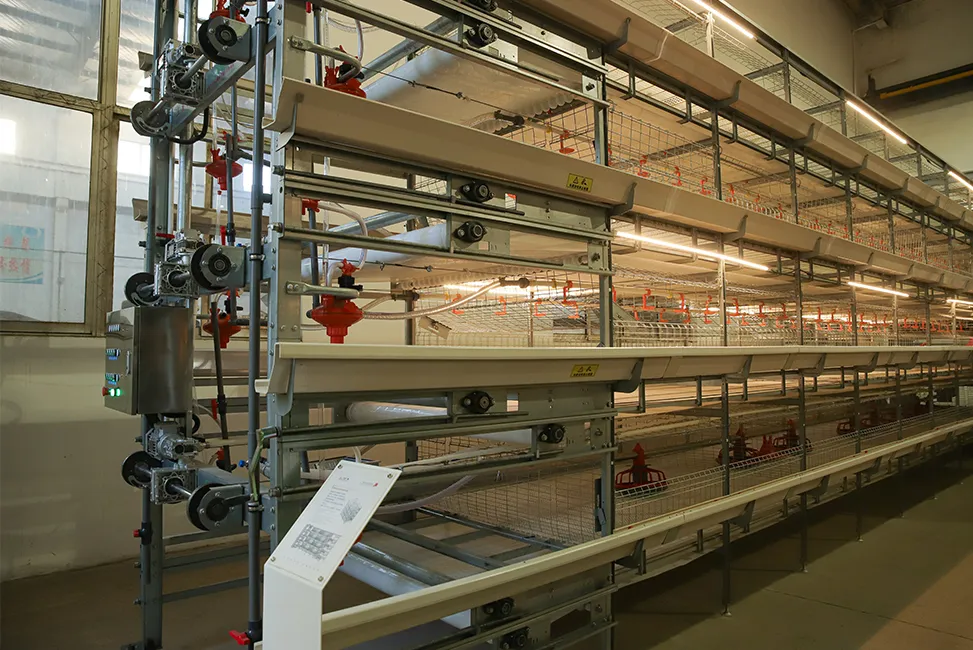
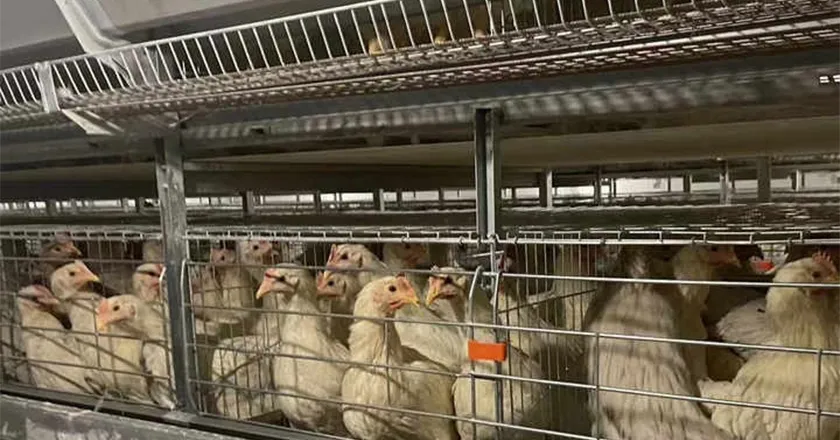
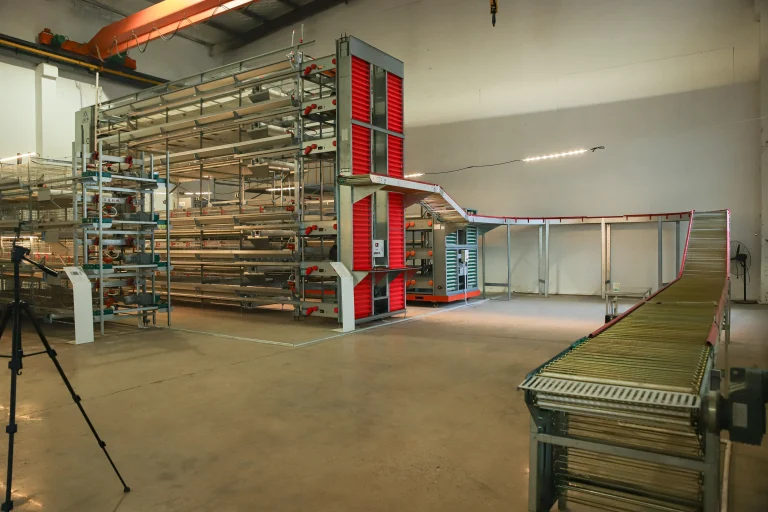
A cage system is one of the best-known commercial housing methods for layer farms. In this system, hens are housed in rows or tiers, often with automatic feed and water, manure removal, and sometimes egg collection by egg belt. Your site’s layer category describes A-type and H-type Hệ thống lồng nuôi theo tầng with automatic feeding, drinking, egg collection, manure removal, and climate control for commercial egg farms.
The big advantage of cage housing is control. A producer can better manage egg collection, bird density, manure flow, and labor. Eggs stay cleaner because they do not remain in litter. Feed waste can be lower. Labor for collection and cleaning can also be lower. Your site’s comparison article on deep litter vs battery cage highlights these same points: better egg cleanliness, more controlled feed intake, cleaner house conditions, and easier manure management.
For breeder farms, the system changes slightly because fertility, mating, nest access, and selective feeding matter more. That is where automatic breeder cage systems or breeder rearing and cage systems come in. These are built for parent stock farms where the hen, rooster, fertility rate, hygiene, and breeder management are the priority.
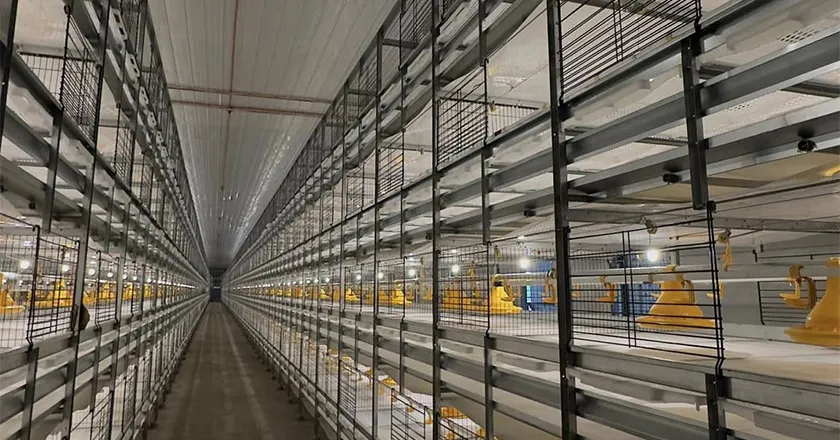
Not all indoor layer housing uses cages in the traditional sense. Cage-free systems are indoor systems where birds can move more freely and have access to nest, perch, feed, water, and litter areas. United Egg Producers says the three main cage-free housing options are single-level all-litter floor systems, multi-tier systems, and aviaries, and that all of them provide dedicated nests, feed and water, perches, and scratching areas.
An aviary house is a cage-free indoor layout with multiple levels or tiers that allow birds vertical and horizontal movement. Purdue Extension explains that aviary systems give hens access to different tiers and a litter or floor area, unlike conventional cages. This creates a different house design with more open movement and more management attention around floor eggs, nesting behavior, and bird movement.
Some producers also use enriched or colony systems, which sit between traditional cage and cage-free models. These systems may include nest areas, perches, and scratch pads. The exact terminology varies by market and welfare regulation, but the broad point is simple: modern housing options now include several alternatives between classic battery-style cage and completely outdoor free-range systems.
For broiler production, the most common house type is the littered floor broiler house. ScienceDirect’s poultry housing overview notes that broilers are typically produced in littered floor systems in a closed structure with access to feed and water systems. FAO also describes commercial houses for meat birds as clear-span litter-floor structures.
This makes sense because meat birds are grown quickly, and the housing goal is efficient growth, stable temperature, clean litter, and easy management from arrival to transport. Broiler houses often focus on ventilation, cooling, heating, drinker lines, feeder lines, and manure or litter condition rather than nest design. In many intensive systems, the building is long, well-insulated, and engineered for airflow. USDA’s poultry industry material emphasizes the importance of house environment and ventilation in commercial bird performance.
If your project is aimed at meat production, broiler production systems or broiler meat production solutions are the more relevant direction than layer cages. These pages align with floor rearing, automated feeding, drinking, climate control, manure removal, and commercial-scale broiler house design.
Brooder houses are designed for the early life stage of the chick. The goal is warmth, protection, stable temperature, easy access to feed and water, and a layout that supports early growth. This is different from a layer house or broiler finish house because very young birds cannot regulate body heat well and are more sensitive to floor, drinker, feeder, and air conditions.
In more advanced farms, brooding and rearing may be split into different phases. A brooder house focuses on the first part of life, while rearing houses prepare pullets or breeders before production. Your site’s fully automatic layer brooder cages page reflects that logic by presenting a rearing system built for raising layer chicks into cages with corrosion-resistant structure and automatic management. (poultry equipment manufacturer in China)
This matters because many new investors think only about the laying or meat house. In reality, early-stage housing has a major effect on later output. A weak brooding layout can reduce uniformity and later performance across the whole flock. That is why many large and medium projects connect the house plan with a hatchery and brooding system rather than buying isolated equipment.
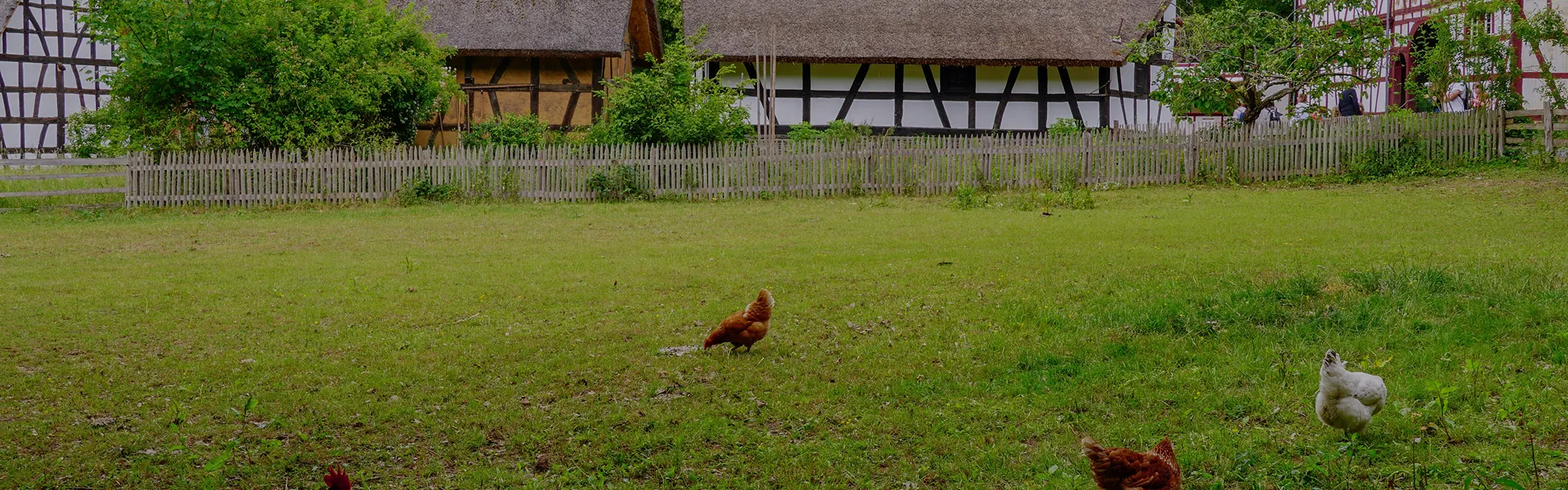
A free-range system gives birds some form of outdoor access. Maryland Extension notes that temporary or portable housing can be moved around property and is often used when birds are raised on pasture; outside runs with fencing and overhead protection may also be needed depending on breed and location.
The advantage is market appeal and more natural movement for the birds. Some farms use free-range or pasture systems because customers value outdoor access. But these systems also need more land, stronger predator protection, more labor in some cases, and careful biosecurity. A producer may still need an indoor house for night, weather, laying, or brooding.
In other words, free-range is not “no house.” It is a different housing system where the house and the outdoor area work together. For many commercial farms, especially in hot, wet, or high-risk disease areas, indoor controlled houses are still the main system, while free-range or outdoor access is more suitable for specific markets and farm models.
A modern poultry house needs more than a roof and four walls. It needs a support system for feed, water, manure, temperature, airflow, and daily operation. Maryland Extension recommends a well-drained site with access to water and electricity, while USDA and other commercial guides stress ventilation and house environmental control as key parts of poultry management.
In a turnkey project, that usually means integrating:
Your site’s support category explicitly lists feeding systems, climate and environment control, incubation and hatchery systems, manure and organic fertilizer systems, and transport/cold chain as supporting parts of modern poultry farms. That is why buyers looking for a complete solution often start with farm support & auxiliary systems plus the main production house.
The right choice depends on bird purpose, market goal, farm scale, welfare target, labor level, and budget. If the priority is egg cleanliness, high-density production, and easy collection, a layer cage system may be the better fit. If the priority is meat production and litter-based broiler growth, a broiler floor house may be the best fit. If the priority is specialty marketing or outdoor access, free-range or pasture-based systems may fit better.
Buyers should ask these questions before deciding:
For larger commercial farms and integrated investors, the best step is often to request a full layout recommendation instead of asking for one machine only. Your site’s catalog, about us, and contact page all position your company as a turnkey supplier for layer, broiler, breeder, hatchery, climate, and manure systems, which is exactly the kind of support buyers need when choosing the right housing system for a long-term project.
| System | Best for | Main strength | Main challenge |
|---|---|---|---|
| Deep litter | Broilers, some layers | Lower entry barrier, simpler house flow | Litter and manure management |
| Cage | Layers, breeders | Cleaner eggs, easier control, lower labor | Welfare concerns in some markets |
| Aviary | Cage-free layers | More movement, nest/perch access | More complex bird behavior management |
| Colony / enriched | Lớp | Mix of control and enrichment | More equipment cost than simple cages |
| Brooder house | Chicks | Better early temperature control | Must be managed carefully in first stage |
| Free-range | Specialty egg or meat farms | Outdoor market appeal | Predator, land, and biosecurity pressure |
These are the core different types of foundations — sorry, housing types — buyers usually compare when designing a modern poultry project. The answer is not universal. The best house is the one that matches your operation.
What are the main types of poultry housing?
The main types include deep litter houses, cage systems, cage-free and aviary systems, free-range or pasture systems, brooder houses, broiler houses, and breeder houses. The exact choice depends on bird type and production goal.
Which poultry house is best for layers?
For commercial egg production, many farms choose layer cage systems because they improve egg collection, hygiene, and labor control. Some producers choose cage-free or aviary systems instead because of market or welfare requirements.
What is a deep litter system?
A deep litter system is a house where birds stay on a litter-covered floor made of absorbent material such as straw or shavings. It is common in broiler production and some smaller poultry farms.
What is the difference between cage-free and aviary systems?
Both are cage-free indoor systems, but aviary houses usually use multi-tier levels that let hens move vertically and horizontally, while simpler cage-free systems may be more open-floor based.
Which housing system is best for broilers?
Broilers are commonly raised in littered floor houses designed for meat production, with focus on feed, water, ventilation, temperature, and litter management.
Do small farms and large farms use the same poultry house design?
Not usually. Small farms may use simpler houses or outdoor systems, while larger commercial projects use engineered poultry houses with automatic feeding, drinking, manure handling, and climate control.
The most common poultry housing systems are deep litter, cage, cage-free, aviary, free-range, brooder, broiler, and breeder houses.
A poultry house should match bird type, farm goal, labor level, and market requirements.
Deep litter houses are common for broilers and some smaller farms, while cage systems are widely used for layers and breeders.
Aviary and other cage-free systems give birds more movement but require more behavior and egg management.
Modern poultry housing should integrate feed, water, climate control, manure removal, and building design as one system.
For commercial buyers, turnkey planning is often better than buying separate equipment pieces without a full layout plan.
A bad coop layout can lead to wet bedding, broken eggs, dirty feeders, poor airflow, and s…
A hatchery can lose output fast when one key machine is missing or poorly planned. Bad egg…
Chúng tôi sẽ trả lời yêu cầu của quý khách trong vòng 24 giờ. Đối với các yêu cầu khẩn cấp, vui lòng liên hệ với chúng tôi qua WhatsApp: +86 133 6144 9578 hoặc gọi trực tiếp cho chúng tôi.
*Chúng tôi tôn trọng quyền riêng tư của bạn. Tất cả thông tin được cung cấp đều được bảo mật tuyệt đối.
Thông tin của bạn chỉ được sử dụng để trả lời câu hỏi của bạn. Chúng tôi không bao giờ gửi email hoặc tin nhắn quảng cáo không mong muốn.