











Fully Automatic Turnkey System for Broilers: What’s Included
What a fully automatic turnkey broiler system actually includes — a scope matrix showing w…

اطّلع على آخر أخبارنا,
 10:12
10:12 Mugong’s H-Type Automatic Broiler Cage with Harvesting System is a multi-tier caged broiler system with chain-type automatic harvesting, built to cut labour, bird injury rate and catch-out cost. Tier count and cage dimensions are configured per house rather than published as a fixed table. Below is the spec set to request, and the geometry that decides it.
أن H-type broiler system is not a cage shape choice. It is a decision to stack live weight vertically inside a fixed building envelope, and every other number in the project follows from that.
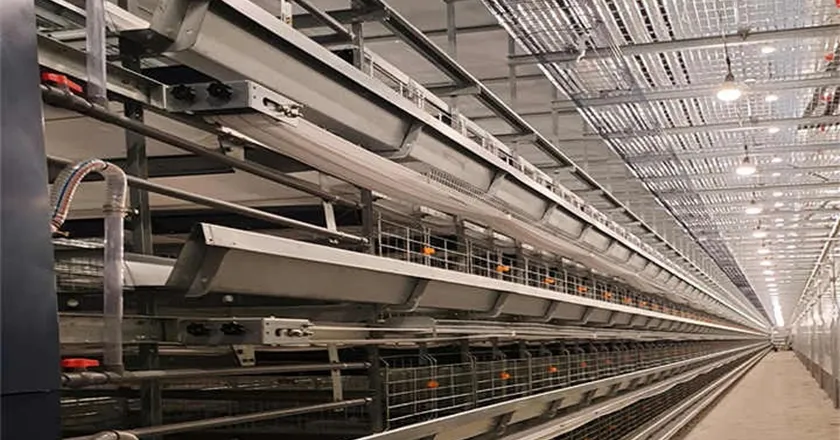
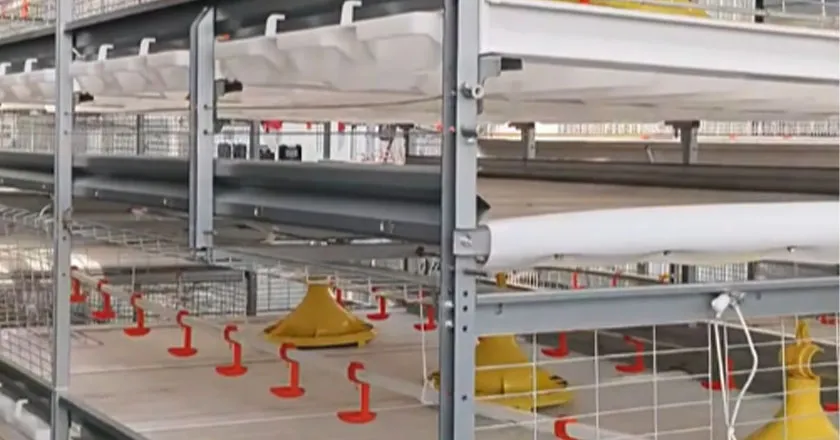
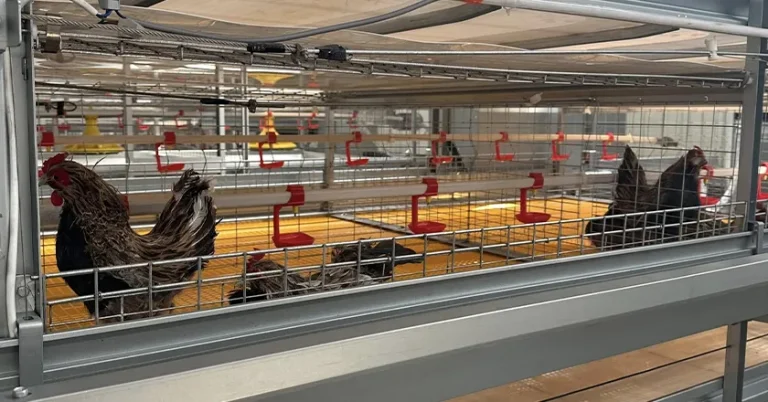
The frame carries cage tiers on vertical columns, with a service aisle on each side of a row and a manure belt running under every tier to a cross conveyor. Feed and water lines are distributed per tier. Because each tier has its own belt, droppings leave the house continuously instead of accumulating as litter under the birds. Bird retrieval at the end of the cycle happens through the chain-type harvesting system rather than by crews walking a litter floor.
The A-frame alternative slopes tiers outward so manure drops to a shared scraper channel or belt below, which limits practical tier count and consumes more floor width per bird. Floor rearing keeps everything on one level, so building footprint scales almost linearly with batch size.
That distinction gets flattened in most product pages in this category into a shape comparison. The decision-relevant differences are density per square metre of building, the labour hours consumed at depopulation, and the clear height your existing or planned house can offer.
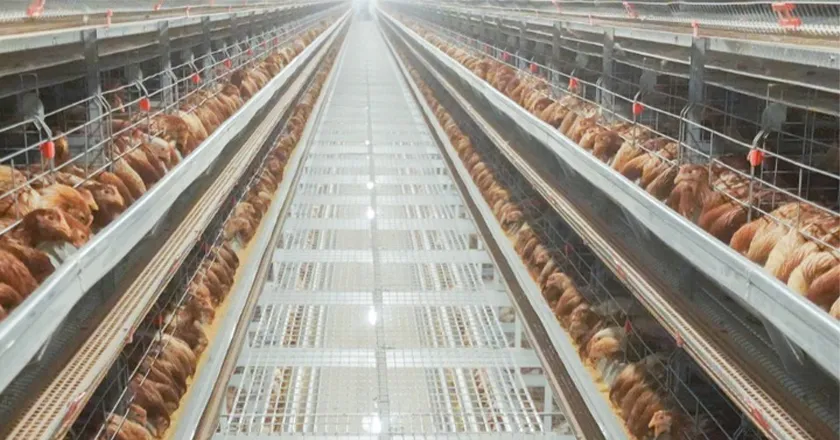
Mugong publishes the H-Type Automatic Broiler Cage with Harvesting System at system level.
| المعلمة | Mugong published status | Category reference (other suppliers’ pages, not a Mugong spec) |
|---|---|---|
| نوع النظام | Chain-type automatic harvesting broiler cage | H-frame battery, automatic harvesting |
| Core automation | Automatic feeding, drinking, manure removal | Same function set, plus climate control packages |
| Tier count | Not published (configured per house) | 3–4 tiers most commonly listed |
| Cage module L × W × H | Not published | Frequently listed as 1,050 × 800 × 420 mm |
| Birds per cage module | Not published | Not consistently stated |
| Column spacing / aisle width | Not published | Not consistently stated |
| Total system height by tier | Not published | Not consistently stated |
| Frame and mesh coating | Not published for this model; the company positions aluminized-zinc mesh on its H-type layer cage, stated as 3–4× more corrosion resistant than ordinary hot-dip galvanized wire, and cites 500+ hour salt-spray validation | Hot-dip galvanized Q235 with 20-year life claims; coating weight rarely given |
| Rearing window | Not published | Systems described for day-old chicks to roughly 42–45 days |
| Certification | ISO 9001:2015, CE, SGS at company level; no per-model certificate numbers published | Varies |
If you are pricing a project rather than browsing, the request list below turns those blanks into a comparable quote. Send it before you accept any per-bird figure:
Item 6 is the one buyers skip and later regret. Cage geometry can be fixed by adding rows; harvesting throughput cannot be fixed after the house is built.
House geometry sets tier count, not the reverse. Two constraints run at the same time.
Span works from the row pitch outward. Each row consumes cage depth on both sides of the frame plus a service aisle, and the aisle is usually the largest single dimension in that repeat. Mugong’s H-type layer cage is the product family where the company does publish geometry, and the proportions there show why: column spacing 1,200 mm, trough spacing 1,570 mm, aisle width 2,055 mm, cage height 710 mm per tier, with total system height from 2,330 mm up to 6,580 mm depending on configuration and required roof height from 2,860 mm to 7,110 mm. Those are layer cage figures and must not be transferred to a broiler quote, but the ratio holds across H-frame systems: aisles and frame consume a fixed share of span, and that share does not shrink when you add tiers.
Height works downward from the truss. Tier stack plus manure belt clearance under the lowest tier, plus header clearance above the top tier for feed line access and lighting, has to sit under the lowest structural or duct obstruction. A house that comfortably takes three tiers will often refuse a fourth by 300 to 600 mm, which is why retrofit feasibility is a clear-height question before it is a floor-area question.
To see the payoff, take the house configuration published across category pages for this class of system: an internal envelope of roughly 104 × 15 × 4.2 m running four tiers in four rows, quoted at just over 50,000 broilers per batch. That works out to about 32 birds per square metre of building floor. On a single-level floor house, the same 1,560 m² carries whatever your welfare standard permits at one level. The arithmetic of a four-tier system is not four times a floor house, because aisles and frame absorb part of the footprint; expect roughly two to two and a half times the birds per square metre of building at equivalent in-cage density. That multiple, not the cage price, is what justifies the system on expensive or permit-constrained land.
Density is a destination-market variable, not an equipment variable. The cage supplies floor area; your buyer’s market rules decide how many kilograms may sit on it. Work it in this order:
Enriched-cage and stocking-density requirements differ substantially between the EU, national schemes and export-processor contracts, and they are revised; FAO poultry production guidance and the applicable national or EU animal-welfare cage standard are the references to verify at the time of purchase, not to assume from a supplier page.
Turnaround then multiplies whatever batch capacity survives step 4. Category product pages describe H-frame broiler systems for day-old birds through roughly 42 to 45 days, which leaves room for six to seven cycles a year once cleaning and downtime are deducted. Annual output is batch capacity times cycles, so a system that shortens the gap between batches is worth more than a system that adds a few birds per cage. Two things drive that gap: how fast the house empties at catch-out, and how fast tiers and belts can be washed and dried.
Twenty-year lifespan claims are near-universal in this category and almost never come with a coating weight. A frame and a mesh can carry very different coatings inside the same quoted system, and mesh is what fails first because it holds moisture at the weld points.
Mugong’s published durability position rests on aluminized-zinc wire mesh, stated at 3–4 times the corrosion resistance of ordinary hot-dip galvanized wire, with 500+ hour salt-spray testing cited as internal validation. That specification is published for the H-type layer cage; for the broiler cage, ask which coating the quoted build uses and get it written into the contract rather than inferred from the product family.
Broiler cage houses differ from layer houses in one way that matters here. Continuous belt manure removal reduces standing ammonia compared with litter systems, but wash-down between six or seven cycles a year means far more wet cleaning per year than a layer house running an 80-week flock. High-frequency washing plus tropical humidity is the condition set to specify against, particularly on coastal sites where chloride load accelerates coating failure.
| Decision Dimension | قفص بطارية من النوع H | قفص بطارية من النوع A | Floor (Litter) Rearing |
|---|---|---|---|
| Birds per m² of building | Highest; scales with tier count | Moderate; tier count limited by frame geometry | Lowest; one level only |
| Practical tier count | 3–4 typical in this category | Usually fewer | None |
| مناولة السماد الطبيعي | Belt per tier with continuous removal | Shared channel or belt below sloped tiers | Litter removed between batches |
| Catch-out method | Chain-type automatic harvesting to a collection point | Mostly manual removal from tiers | Manual crews working across the floor |
| Depopulation labour | Lowest; crew size is determined mainly by loading rather than catching | Manual handling required at height | Highest; typically requires a full crew and often night work |
| Clear height required | Highest; often the key constraint in retrofit projects | معتدل | منخفضة |
| Capex per bird | Highest equipment cost, but lowest building cost per bird | Middle | Lowest equipment cost, but highest building cost per bird |
| Cleaning between batches | More tier and belt surfaces, but faster dry-down | Similar surfaces with somewhat less accessibility | Simplest surfaces, but includes litter disposal cost |
| Inspection access | Aisle access to every tier | Aisle access with sloped sight lines | Full walk-through access |
| Market acceptance | Check destination-market welfare regulations before ordering | The same welfare-rule check applies | Widest acceptance in welfare-labelled markets |
Compared with the equipment-only packages most commonly marketed in this category, the cage frame is the smaller half of the decision. Building cost per bird moves in the opposite direction to equipment cost per bird, and the crossover point sits at your land price and your permit timeline. Mugong’s Broiler Floor Farming Equipment line exists for projects that land on the other side of that crossover, which is a real outcome and not a downgrade.
Mugong‘s broiler cage is specified as a chain-type automatic harvesting system, described as reducing labour, injury rate and catch-out cost. Those three consequences are worth separating, because they hit different lines in a budget.
Labour is the visible one: catching crews are seasonal, priced at short notice, and often work nights. Injury rate is the quieter one, since wing and leg damage from manual catching arrives as downgrades and condemnations on the processor’s kill sheet weeks after the crew has been paid. Catch-out cost also includes the hours the house sits full and unproductive while emptying, which is cycle time you are paying rent on.
One failure mode to plan around: harvesting throughput has to match truck cadence. If your processor allocates fixed delivery slots, a chain running faster than trucks arrive means crated birds waiting, and a chain running slower than the slot window means missed slots and a second collection day. Ask for the birds-per-hour figure and multiply it against your slot schedule before you sign.
“The cage system includes the ventilation design.” Stacking tiers changes air distribution inside the house. Tunnel velocity that works over a litter floor does not automatically reach the third and fourth tier evenly, and static pressure and inlet layout have to be recalculated per tier count. Treat ventilation as a separate engineering scope with its own numbers.
“We have the floor area, so we can retrofit.” Floor area is rarely the constraint. Clear height under the lowest obstruction, door and access dimensions for installing frames, and slab flatness under the frame line usually decide feasibility.
“Fully automatic means unattended.” Automation moves labour from catching and mucking out to monitoring, calibration and mechanical maintenance. Belt tracking, nipple line pressure and drive chain condition need scheduled attention, and the skill profile you hire for changes accordingly.
Mugong does not publish a per-bird figure for the H-type broiler cage system. Broiler cage projects are quoted per house because tier count, coating specification, harvesting throughput and climate package move the total substantially. Treat any single per-bird number for a broiler cage system as a lead magnet until it is tied to a named configuration.
There is one widely republished figure worth handling carefully. The commonly cited range of roughly US$15–25 per bird capacity for automatic layer battery cage systems is stated in its source as including housing and equipment. It is regularly requoted as if it were an equipment-only price, which understates a turnkey budget and overstates an equipment budget. It is also a layer figure, not a broiler figure.
The variables that actually move a broiler cage quote: bird capacity and tier count; manual, semi-automatic or fully automatic specification; galvanized versus aluminized-zinc structure; climate-control depth for ventilation, cooling and heating; whether a steel-structure house is in scope; destination country freight, certification and installation; and total turnkey scope from equipment-only through to EPC delivery.
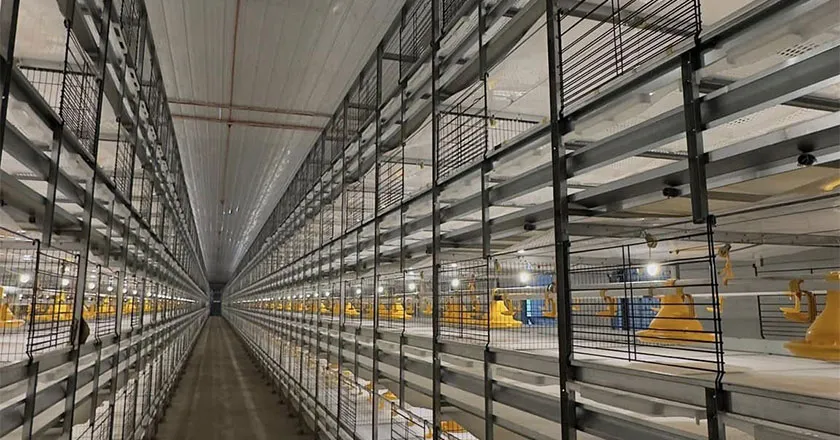
Q: How many tiers can a fully automatic H-type broiler cage run?
A: Mugong does not publish a fixed tier count for this model; it is configured per house. Across this equipment category, three and four tiers are the configurations most commonly listed. Your ceiling is clear height under the lowest obstruction, not the frame design.
Q: What are the cage dimensions of the Mugong H-type broiler cage?
A: Cage module dimensions are not published for this model. Request module external dimensions, usable internal floor area, and birds per module at your target market weight. Figures such as 1,050 × 800 × 420 mm circulate as a category reference on other suppliers’ pages and should not be assumed for a Mugong quote.
Q: Can an existing broiler house be retrofitted with H-type cages?
A: Sometimes, and clear height decides it. You need tier stack height plus manure belt clearance below the lowest tier plus service clearance above the top tier to fit under the lowest structural or duct obstruction. Floor area is usually the easier constraint to satisfy.
Q: How much does a fully automatic H-type broiler cage system cost?
A: Quote-based. There is no published Mugong per-bird figure for this system, because tier count, coating specification, harvesting throughput, climate package and whether a steel-structure house is included all move the total. Per-bird figures circulating for layer systems include housing in their source definition and do not transfer to broiler cages.
Q: Is the harvesting system worth paying for on a smaller farm?
A: It depends on your catching labour market and your processor’s downgrade schedule, not on farm size alone. Where catching crews are scarce, priced at short notice, or where wing and leg damage is being deducted from your kill sheet, the automatic system recovers cost faster than the headline capex suggests.
Q: What certification does the equipment carry?
A: ISO 9001:2015, CE and SGS at company level. Per-model certificate numbers are not published, so request the applicable certificate copies for the specific configuration you are buying, together with any destination-country conformity documents your import regime requires.
What a fully automatic turnkey broiler system actually includes — a scope matrix showing w…
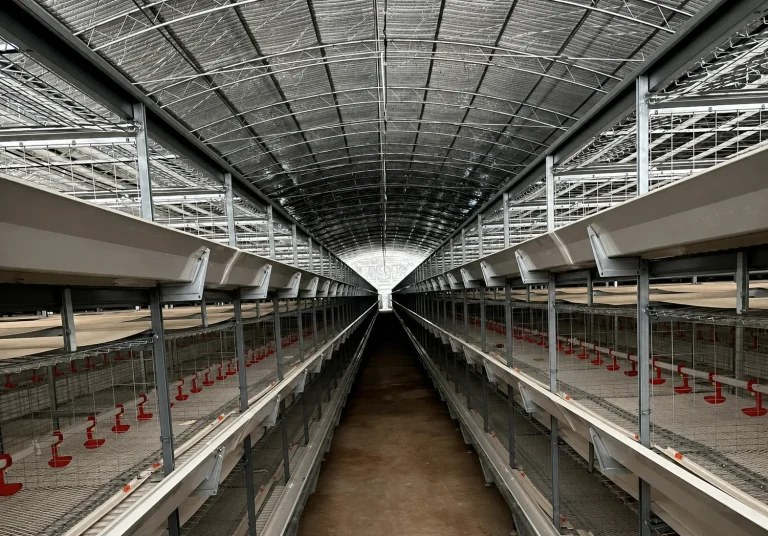
Full spec breakdown of the fully automatic H-type battery cage for broilers: tier count vs…
سنرد على استفسارك في غضون 24 ساعة. للاستفسارات العاجلة، يرجى الاتصال بنا عبر WhatsApp: +86 133 6144 9578 أو الاتصال بنا مباشرة.
*نحن نحترم خصوصيتك. جميع المعلومات المقدمة سرية للغاية.
سيتم استخدام بياناتك فقط للرد على استفسارك. نحن لا نرسل أبدًا رسائل بريد إلكتروني أو رسائل ترويجية غير مرغوب فيها.