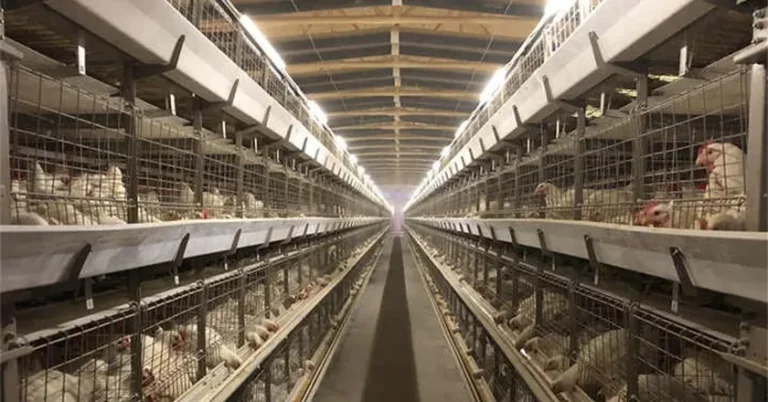
Poultry automation equipment replaces five discrete manual tasks — feeding, drinking, egg collection, manure removal, and climate control — with mechanized systems built into layer cages and poultry houses. Equipment-only costs run roughly $15–25 per hen capacity, or $18,000–32,000 for a 10,000-hen cage system, before house construction or site works are added.
Where Supplier Claims Leave a Gap
Most supplier pages selling automated cage systems lead with a single labor-saving headline: one worker can manage 100,000 hens. What’s usually missing is which tasks that number assumes are automated and which are still done by hand. Compared to that kind of single-figure claim, a function-by-function breakdown gives a buyer something to check against their own labor cost per hen, rather than a number to take on faith.
Automation equipment covers five distinct functions inside a layer or broiler house. Each one replaces a specific manual task — not a percentage of “labor” as an abstract category. The table below maps each function to what it removes, using the automated components built into a standard H-type layer battery cage.
Five Functions Automation Actually Replaces
| Automation Function |
Manual Task It Replaces |
Equipment Basis (H-Type Layer Cage) |
| Alimentazione |
Hand-distributing feed along every tier, several times a day |
Automatic feeding line integrated along each cage row |
| Bere |
Manually refilling and leak-checking drinkers per cage |
Automatic drinking line built into each tier |
| Prelievo degli ovuli |
Walking each row to hand-collect eggs multiple times daily |
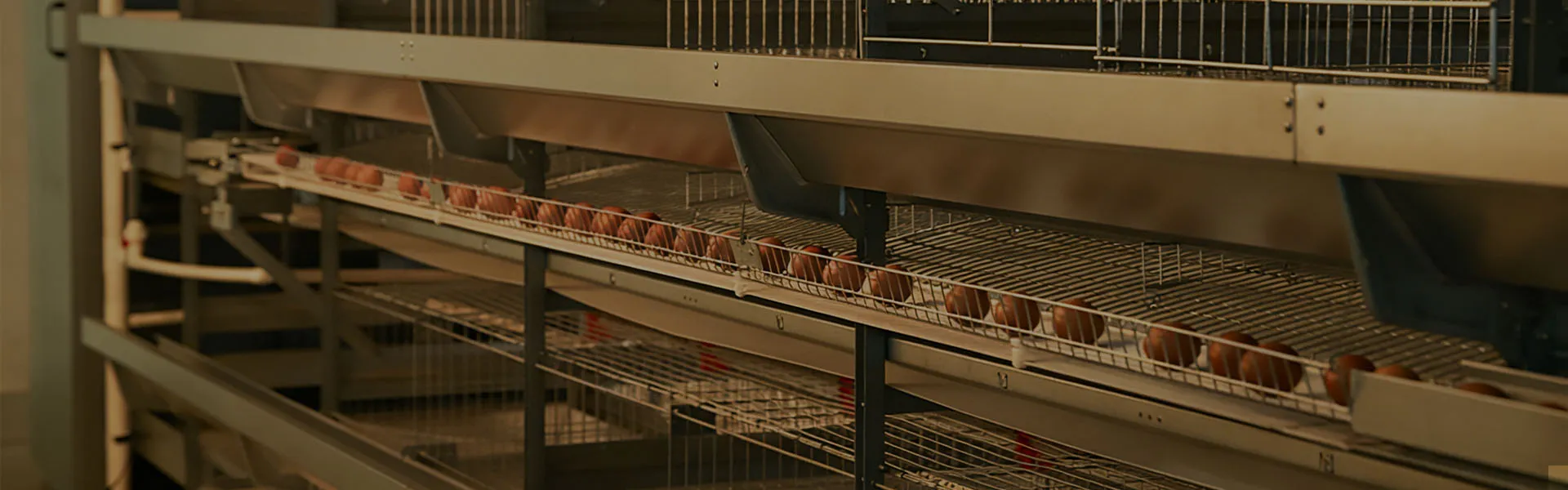
Automatic egg collection belt per tier |
| Rimozione del letame |
Scraping or shoveling manure out from under each row |
Automatic manure removal belt beneath each tier |
| Climatizzazione |
Manually adjusting vents or curtains by observation |
Integrated climate control tied to the house structure |
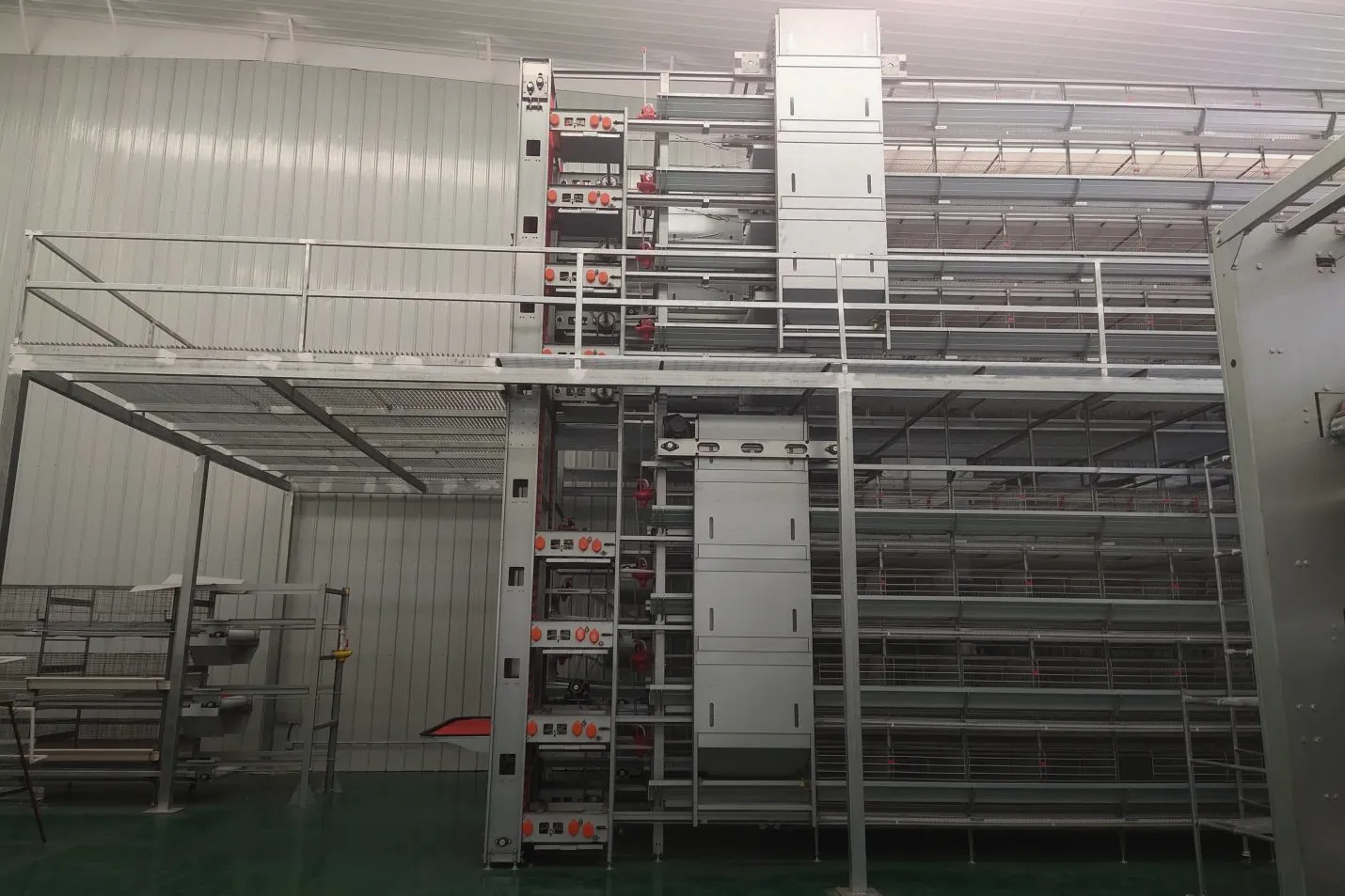
Physically, these functions are built into the cage structure, not bolted on afterward. Tier configurations on the H-Type system run 3, 4, or 5 tiers, or stacked 3+3 and 4+4 arrangements, with a fixed cage height of 710 mm per tier and total structure heights from 2,330 mm up to 6,580 mm depending on tier count. Column spacing is set at 1,200 mm and trough spacing at 1,570 mm, with a 2,055 mm aisle width for service access. That spacing isn’t arbitrary — it’s what lets the feeding, drinking, egg collection, and manure removal lines align across every tier at once.
What a 10,000-hen Automation Package Costs
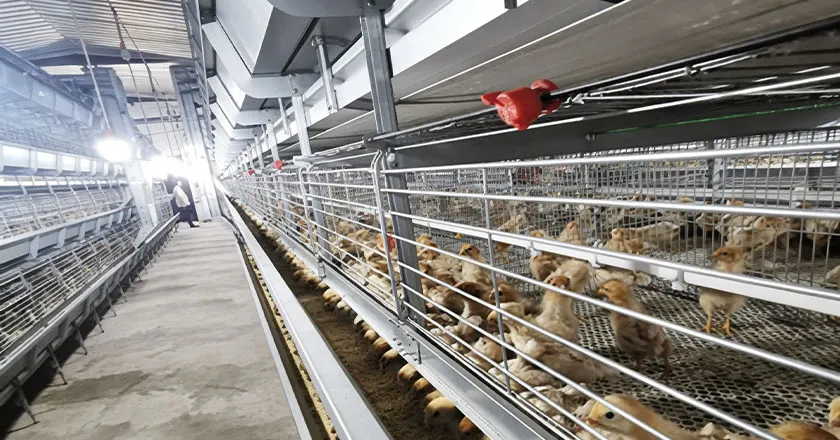
Cost scales with hen capacity and automation depth more than with house footprint alone.
| Project Scale |
Equipment-Only Cost Range |
Basis |
| Per hen Capacity (General) |
~US$15–25 per hen |
Industry-standard investment range for H/A-type systems |
| 10,000-hen Layer Cage Project |
~US$18,000–32,000 |
Varia a seconda del grado di automazione e delle caratteristiche dell'acciaio |
| 20,000-Layer Fully Automatic System |
~US$35,000–120,000 |
Varies with automation configuration level |
| Full Turnkey (Cage + House + Site Works) |
Quote-based |
Construction, site preparation, and freight are priced separately |
These are reference ranges published to help a buyer self-qualify a budget, not a fixed quote for any specific project — actual pricing depends on the drivers below:
- Hen capacity and tier count
- Manual vs. semi-automatic vs. fully automatic configuration
- Galvanized vs. aluminized-zinc structural wire
- Climate-control depth (ventilation, cooling, heating)
- Whether a steel-structure house is included
- Destination country (freight, certification, installation)
- Turnkey scope: equipment-only vs. full EPC
Automation Reduces Labor. It Doesn’t Eliminate It.
A common assumption is that a fully automatic system means the house runs itself. It doesn’t. Feeding lines, drinking lines, egg belts, manure belts, and climate control still need someone checking for jams, alarms, and mechanical wear — the labor shifts from repetitive manual tasks to monitoring and maintenance, it doesn’t disappear.
There’s a second effect worth flagging before ordering: all five functions on a fully automatic system typically run off the same power supply. A manual house can keep feeding, watering, and clearing manure by hand through a power outage. A fully automated house loses all five functions at the same time until power or backup generation is restored. That dependency isn’t a defect in the equipment — it’s a scoping question a buyer needs to answer for their own site before committing to full automation over a semi-automatic configuration.
Inside the H-Type Automatic Layer Battery Cage
The related equipment for this breakdown is the H-Type Automatic Layer Battery Cage. Beyond the tier and spacing figures above, the structure uses aluminized-zinc wire mesh, rated by the manufacturer at 3–4 times the corrosion resistance of ordinary hot-dip galvanized wire, validated through 500+ hours of salt-spray testing.
Certification on this product line sits at the company level: ISO 9001:2015, CE, and SGS third-party inspection. No per-model certificate numbers are published for this cage, so a buyer verifying compliance should request the company-level certificates directly rather than looking for a model-specific document.
Where the Trade-offs Actually Bite
What automation buys you:
- Five recurring manual tasks replaced with integrated equipment, verifiable against the spec table above
- A structural corrosion-resistance rating (3–4x ordinary galvanized wire) backed by third-party salt-spray testing
- Labor that no longer scales linearly with hen count for feeding, watering, collection, and manure handling
What it costs you beyond the sticker price:
- Higher upfront capital per hen than a manual (Type A) layout — $15–25 per hen before construction
- Full dependency on continuous power across all five functions simultaneously, with no manual fallback
- A maintenance skill requirement that a manual system doesn’t have
- Equipment-only pricing that excludes house construction, site works, freight, and installation, all quoted separately
Domande frequenti
Does the per-hen price include the poultry house itself?
No. The per-hen and per-project ranges above cover cage and function equipment only. Steel-structure housing, site works, freight, and installation are priced separately as part of a turnkey scope.
What’s the practical difference between semi-automatic and fully automatic systems?
Semi-automatic configurations mechanize some functions, commonly feeding and drinking, while manure removal or egg collection may still be manual. Fully automatic systems, like the H-Type layer cage, integrate all five functions into the cage and house structure. Automation depth is one of the explicit cost drivers listed above.
Why does climate control cost vary so much between projects?
Climate-control depth — how much ventilation, cooling, and heating capacity is built in — is one of the price drivers listed above, along with destination-country freight, certification, and installation requirements.
How do I verify the certification on an automated cage system?
Ask for the company-level ISO 9001:2015, CE, and SGS certificates directly. No per-model certificate numbers are published for this product line, so a model-specific certificate isn’t something to expect or request.













 13:11
13:11